


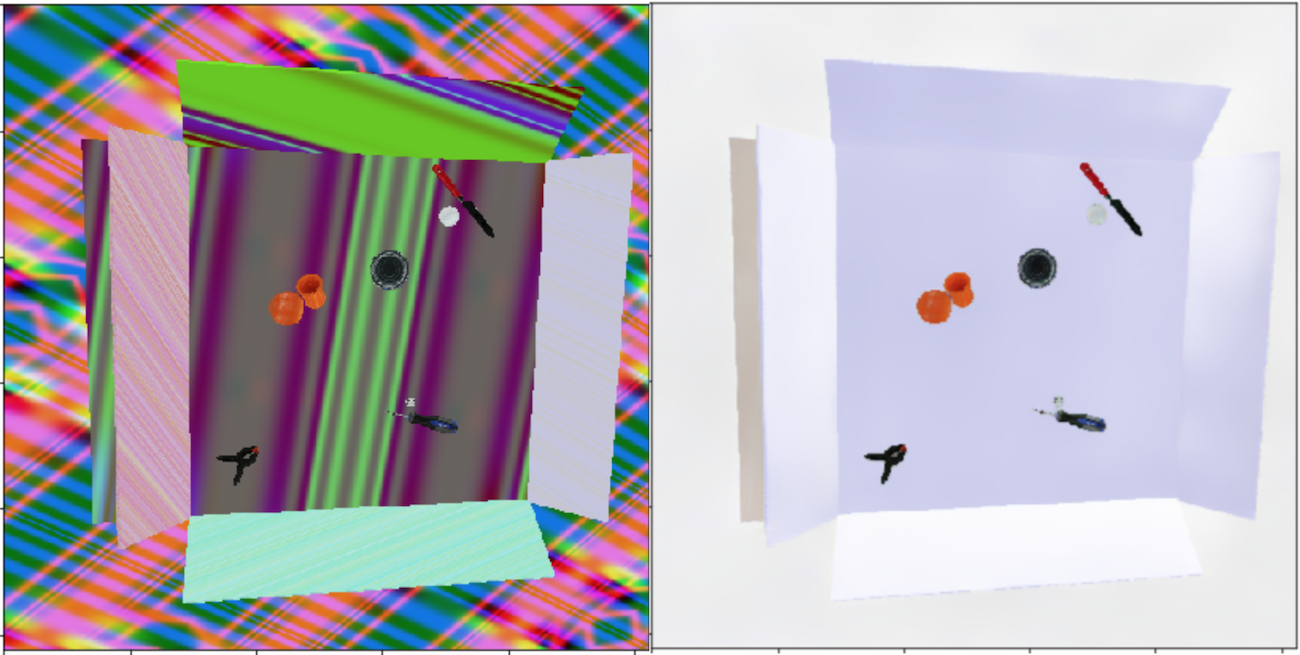
Real2Sim Image Adaptation
Image domain adaptation that maps randomized-texture (or real) images into a single canonical representation. A re-implementation of the RCAN paper, swapping the original GAN loss for a perceptual/feature loss.
I build robot learning systems that work outside the lab, favoring minimal solutions that are easy to understand and rapid iteration over upfront sophistication. My current focus is on dynamic whole-body manipulation, with earlier work in computational robot design for manipulation and outdoor navigation.
I received my Robotics Ph.D. at Georgia Tech, advised by Sehoon Ha, in close collaboration with C. Karen Liu and Jie Tan. Earlier, at Google X, I worked closely with Yunfei Bai and Mohi Khansari.
My goal is to build robot learning systems capable of learning and executing complex physical tasks with elegance, at scale, and with superhuman speed and precision, while remaining safe, reliable, and easily steerable.
Maks Sorokin*, Jan Brüdigam*, Brandon Hung*, Stephen Phillips, Dmitry Yershov, Farzad Niroui, Tong Zhao, Leonor Fermoselle, Xinghao Zhu, Chao Cao, John Z. Zhang, Duy Ta, Tao Pang, Jiuguang Wang, Simon Le Cléac'h
We give Spot the ability to manipulate heavy objects (15kg tires) using its entire body. By combining sampling-based optimization with reinforcement learning, the system enables forceful, multi-contact manipulation that discovers strategies on the fly — handling objects that exceed the robot's nominal payload, at near-human speeds.
Martin Schuck, Maks Sorokin, Simone Manni, Duy Ta, Angela P. Schoellig, Marco Hutter, Simon Le Cleac'h, Jan Brüdigam
selected for a spotlight (top 3.4% of 2,094 submissions)
Sample-based MPC in simulation acts as an automated expert whose offline data solves exploration, so off-policy RL learns loco-manipulation from sparse rewards alone. The policies surpass their optimal-control teacher and transfer to Spot and a Unitree G1 humanoid.
John Z. Zhang, Maks Sorokin*, Jan Brüdigam*, Brandon Hung*, Stephen Phillips, Dmitry Yershov, Farzad Niroui, Tong Zhao, Leonor Fermoselle, Xinghao Zhu, Chao Cao, Duy Ta, Tao Pang, Jiuguang Wang, Preston Culbertson, Zachary Manchester, Simon Le Cléac'h
A sim-to-real approach that enables legged robots to dynamically manipulate large and heavy objects with whole-body dexterity. We combine pre-trained whole-body policies with sample-based planning in a hierarchical controller that generalizes to diverse objects and tasks without retraining — demonstrated on Spot uprighting a 15kg tire and dragging barriers larger than itself, as well as humanoid simulations.
Morgan Byrd, Donghoon Baek, Kartik Garg, Hyunyoung Jung, Daesol Cho, Maks Sorokin, Robert Wright, Sehoon Ha
An autonomous framework that enables humanoid robots to navigate, grasp, lift, and deliver objects with whole-body coordination. A recurrent pose estimator maintains robust state under noisy vision, and the policy generalizes across varying object shapes and masses with adaptive regrasping.
Jan Brüdigam, Ali Adeeb Abbas, Maks Sorokin, Kuan Fang, Brandon Hung, Maya Guru, Stefan Sosnowski, Jiuguang Wang, Sandra Hirche, Simon Le Cleac'h
We combine reinforcement learning with sampling-based planning to solve contact-rich manipulation tasks. Sampling-based planners quickly find successful trajectories, but the resulting solutions often lack robustness. We use RL to distill a set of planner demonstrations into a single policy that handles real-world variation and uncertainty.
Maks Sorokin, Chuyuan Fu, Jie Tan, C. Karen Liu, Yunfei Bai, Wenlong Lu, Sehoon Ha, Mohi Khansari
A learning-oriented morphology optimization framework that jointly accounts for a robot's body, its onboard perception, and how the two interact across tasks. Holistically optimized morphologies improve task performance by 15–20% across a range of manipulation problems, and require 25× less data to match a human-expert-designed morphology.
Mehdi Azabou, Michael Mendelson, Maks Sorokin, Shantanu Thakoor, Nauman Ahad, Carolina Urzay, Eva L Dyer
selected for a spotlight
We introduce Bootstrap Across Multiple Scales (BAMS), a multi-scale self-supervised representation-learning model for behavior analysis. BAMS pools features from encoders with different temporal receptive fields and applies latent bootstrapping objectives in each scale's embedding space, encouraging disentanglement across timescales.
Maks Sorokin, Jie Tan, C. Karen Liu, Sehoon Ha
A system that enables zero-shot transfer of vision-based policies to outdoor sidewalk navigation. Evaluated on a quadrupedal robot walking 3.2 km of real-world sidewalks with minimal human intervention.
Sunwoo Kim, Maks Sorokin, Jehee Lee, Sehoon Ha
A motion-control system that lets a human user drive a quadrupedal robot through a wide range of motor tasks — standing, sitting, tilting, manipulating, walking, and turning — in both simulation and on hardware.
Maks Sorokin, Wenhao Yu, Sehoon Ha, C. Karen Liu
We train a vision-based agent to perform object search in a photorealistic 3D scene, and propose a motion-synthesis mechanism that retargets the agent's head motion onto an animated human character (PFNN/NSM) — transferring its search behavior to a humanoid avatar.
Qian Luo, Maks Sorokin, Sehoon Ha
Vision-based navigation agents can be trained to adapt to new sensor configurations with as few as three shots of experience. Rapid adaptation comes from a bottleneck between the perception and control networks, plus meta-adaptation of the perception component.
Image domain adaptation that maps randomized-texture (or real) images into a single canonical representation. A re-implementation of the RCAN paper, swapping the original GAN loss for a perceptual/feature loss.
A Computer Animation course project: an off-the-shelf Soft Actor-Critic agent learns to build momentum and swing an animated character on a pull-up bar.
An end-to-end image-to-steering control policy, trained via behavior cloning on data from multiple laps and deliberate off-track recoveries recorded by a human driver.
To get in touch please leave me a note filling this form